Commercial script examples you can copy
Five original commercial script examples in a two-column picture and sound layout: local service, product, software, restaurant and a 15-second social ad.
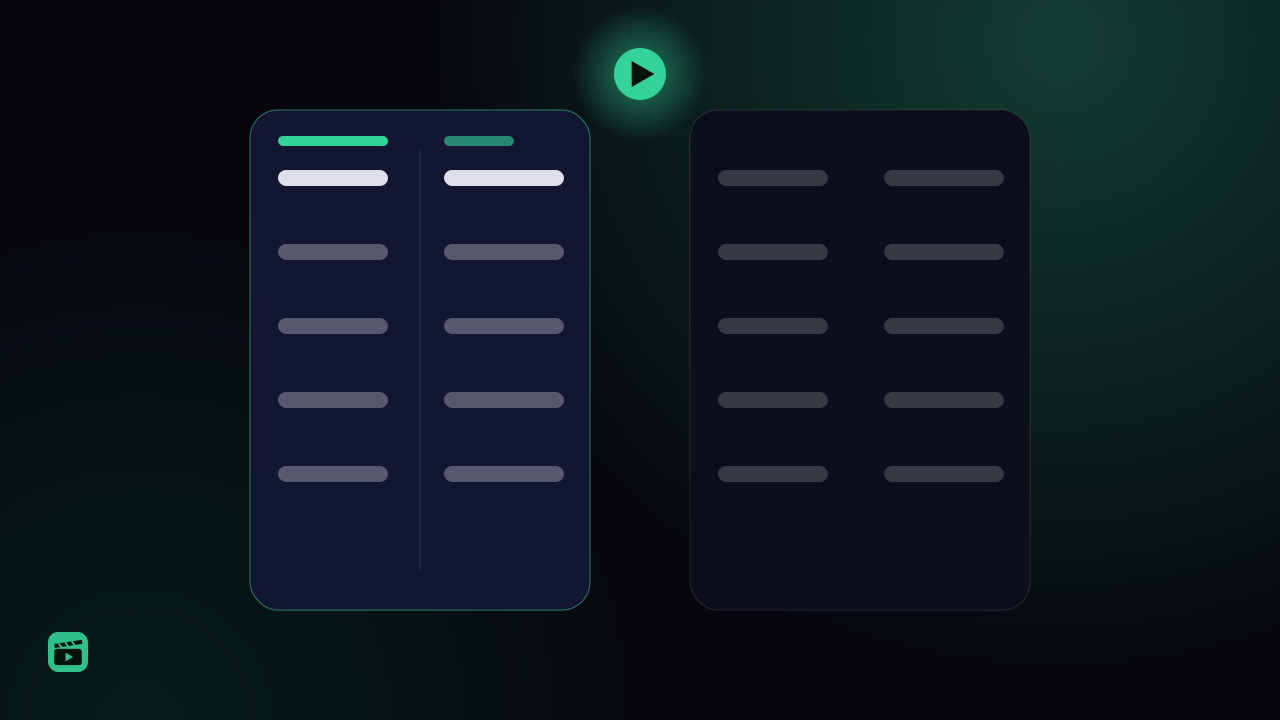
A good commercial script example is a two-column page: what the viewer sees on the left, what they hear on the right, one row for each beat. Below are five original ones you can copy and rewrite for your own business: a local service, a product spot, a software launch, a restaurant and a 15-second social ad. Every brand in them is made up for this post, so there is no real company, no real number and no real customer. Swap in your own facts before you use any line.
The five examples at a glance
| Example | Type | Length | The one message |
|---|---|---|---|
| 1. Harbor Light Plumbing | Local service | 30 seconds | We show up when we say we will |
| 2. Kettlewick | Product spot | 20 seconds | A kettle that stays quiet |
| 3. Tallybook | Software launch | 30 seconds | Invoices that chase themselves |
| 4. Salt & Ember | Restaurant | 20 seconds | Wood-fired food, made in front of you |
| 5. Pocket Pause | Social ad | 15 seconds | Five minutes of calm, anywhere |
Our post on how to write a 30-second commercial script explains the six beats these scripts follow, so this post stays on the examples.
How to read a two-column script
An AV script (audio and video script) is a two-column document: the video column describes what the audience sees, and the audio column describes what they hear, such as narration, music and sound effects. Each row is one synchronized moment. Celtx, which makes scripting software, describes the format this way, and suggests making the video column a little wider so there is room for detail.
Example 1: a local service (30 seconds)
A fictional plumbing company in a fictional town. Local service ads win on trust and on a clear next step, so this one is built around a promise and a phone number.
| Time | Picture | Sound |
|---|---|---|
| 0 to 3 s | Close-up of a drip falling into a cereal bowl on a kitchen counter | A single drip. Voice: "It always starts on a Sunday." |
| 3 to 8 s | A person in pajamas stares at a ceiling stain; a wide shot of a calendar full of work | Voice: "And the first plumber who can come is Thursday." |
| 8 to 12 s | A van pulls up; a technician in a clean uniform steps out. Name on screen: Harbor Light Plumbing | Music lifts. Voice: "Harbor Light Plumbing." |
| 12 to 22 s | Three shots: the tech checks the pipe; a tablet shows the repair steps; the person nods | Voice: "We give you a time window, we show up inside it, and we tell you the fix before we start." |
| 22 to 26 s | Text on screen: "Same-week visits. Written steps first." | Voice: "Same-week visits. Written steps first." |
| 26 to 30 s | End card: logo, a phone number, the fictional town name | Voice: "Call Harbor Light Plumbing. We'll be there when we say." |
Why it works: the hook is a problem moment, shown rather than described. The promise is concrete (a time window, a written plan), and the end card names the town, which tells a local viewer this ad is for them. If you have no real "same-week" promise, do not put one on screen.
Example 2: a product spot (20 seconds)
A fictional kettle. A product spot is mostly about the object: how it looks, what it does and why it is different. It needs fewer words than almost any other type.
| Time | Picture | Sound |
|---|---|---|
| 0 to 3 s | A kitchen at 6 a.m., dark; a hand reaches for a kettle switch | Silence, then a soft click |
| 3 to 7 s | Extreme close-up of water starting to move, then rolling; steam lit from behind | A low hush instead of a roar. Voice: "Most kettles shout." |
| 7 to 12 s | The Kettlewick turns slowly on a countertop; its name appears on screen | Voice: "Kettlewick doesn't." |
| 12 to 17 s | A sleeping partner in the next room, undisturbed; the kettle's light clicks off | Voice: "It boils in near silence, and it shuts itself off." |
| 17 to 20 s | The product big and close; end card with logo and web address | Voice: "Kettlewick. Quiet mornings." A short sting. |
Why it works: the hook is a sound, and the contrast ("most kettles shout") sets up the product in one line. If your product's difference cannot be shown in a shot, it is not ready for a 20-second spot.
Example 3: a software launch (30 seconds)
A fictional invoicing app. Software is hard to film, so the screen has to be the star, and the script has to name the pain before showing a single button.
| Time | Picture | Sound |
|---|---|---|
| 0 to 3 s | A laptop showing a spreadsheet with a red column labeled "Overdue" | Voice: "Another invoice. Another reminder email." |
| 3 to 8 s | A freelancer rewrites the same polite message for the fourth time; a clock on the wall | Voice: "You didn't start a business to chase payments." |
| 8 to 12 s | The Tallybook dashboard slides in; the name appears on screen | Music lifts. Voice: "Meet Tallybook." |
| 12 to 22 s | Three screen shots: an invoice sent in two taps; an automatic reminder going out; a "Paid" badge appearing. Callout: "Reminds for you." | Voice: "Send an invoice in two taps. Tallybook reminds your client until it's paid." |
| 22 to 26 s | Card: "Built for freelancers and small studios" | Voice: "Built for freelancers and small studios." |
| 26 to 30 s | End card: logo, "Try Tallybook at tallybook.example" | Voice: "Try Tallybook today." |
Why it works: the first six seconds contain no product at all, only a feeling the viewer already has. The demo shots each show one action and one result. There is no proof beat, because a fictional product has none. A real number or quote you may use would go there.
Example 4: a restaurant (20 seconds)
A fictional wood-fired restaurant. Food ads live on appetite, so the script gives the pictures most of the work and keeps the voice short.
| Time | Picture | Sound |
|---|---|---|
| 0 to 3 s | A flame licking up the side of a stone oven; a pizza peel slides in | The crackle of a fire. Voice: "Fire. Flour. Fifteen minutes." |
| 3 to 9 s | Close-ups: dough stretched by hand; blistered crust; a ladle of tomato; basil dropped on top | Music builds under the fire sound |
| 9 to 14 s | The cook lifts the pizza out and slides it onto a board; the name appears: Salt & Ember | Voice: "Salt & Ember. Everything made where you can see it." |
| 14 to 20 s | A table of friends tearing slices apart; end card with logo, the street and "Open from 5" | Voice: "Salt & Ember on Mill Street. Open from five." |
Why it works: the sound of the fire is the hook, the middle is pure texture, and the end card gives the two facts a hungry person needs, where and when. One honest limit: close-ups of fire and food are within reach for AI, but a complicated plate assembled by a specific person is harder, so review those shots closely.
Example 5: a 15-second social ad (vertical)
A fictional meditation app. Short ads are not cut-down versions of long ones: they are written fresh. Fifteen seconds gets a hook, one problem shot, the reveal, two quick uses and an offer.
| Time | Picture | Sound |
|---|---|---|
| 0 to 2 s | Vertical close-up of a thumb frozen over a phone. On-screen text: "Your brain, 4:59 p.m." | A notification buzz, then a held breath |
| 2 to 5 s | A packed commuter train; a person's shoulders tense | Voice: "Five minutes. That's all you get." |
| 5 to 8 s | The Pocket Pause screen: a slow circle. Name on screen | Soft tone. Voice: "Pocket Pause." |
| 8 to 12 s | Two shots: a person on a bench with eyes closed; a person at a desk breathing out | Voice: "Five minutes of calm, anywhere you are." |
| 12 to 15 s | End card: logo, "Get Pocket Pause in the app store" | Voice: "Get Pocket Pause." |
Why it works: the text on screen carries the hook for people watching without sound, and the product name lands before the halfway point. Our post on video ad hooks goes through seven hook types you can try in that first slot.
The reusable pattern
All five scripts share the same skeleton, whatever the length:
- One message, written in one sentence before anything else.
- A hook in the first two or three seconds that works with the sound off, through text or a clear picture.
- A problem or a want, shown, not explained.
- The product with its name on screen, big and close.
- One to three shots of it working, each showing one action and one result.
- Proof, only if you have it. A real number, a real rating, a quote from someone who agreed to be quoted.
- One call to action, spoken and written on the end card, with an address that is easy to remember.
Shorter spots drop beats. The 15-second ad above has no proof beat and one problem shot. Longer ones add shots, not messages. Google's creative guidance for YouTube ads uses four letters, ABCD (attract, brand, connect, direct), and that is the same skeleton in short form: get attention from the start, bring the brand in naturally, give the viewer a reason to care, and say what to do.
Common mistakes in commercial scripts
- Three messages in one ad. The viewer remembers none. Choose one and cut the rest.
- Too many words. If the right-hand column takes more than about 22 seconds to read aloud for a 30-second ad, cut words, not shots.
- A vague call to action. "Learn more" asks for nothing. Name the action and the place.
- Picture notes that cannot be filmed. "We feel the warmth of family" is not a shot. Write what the camera sees.
How to turn a script into a storyboard
A script says what happens. A storyboard says what it looks like, shot by shot. For each row of your script, decide the shot size (extreme close-up, close-up, medium, wide), the camera move (a push-in, a pull-out, a static frame), the line said over it, any text on screen, and a picture of the shot. The picture matters most, because a line that reads well can describe a shot that looks wrong.
At customcommercials.ai you write a brief and we turn it into that storyboard. It is free and shot by shot, with a preview still for most shots, so you can change any line or shot before you approve. You then see the exact price for the finished length before you decide, and you pay once, with no subscription. The AI commercials page shows how the pieces fit, commercial cost and pricing have the live price, and video ads covers the short social formats. Not sure whether you need an ad or an instructional video? See commercial or instructional video: which one you need.
FAQ
What is a commercial script?
A commercial script is the written plan for an ad. It is usually a two-column page: the picture on one side and the sound (voice, music, effects) on the other, with one row for each beat. It is written before any filming or generating, so the idea can be fixed on paper first.
How long should a commercial script be?
It depends on the length of the ad. A 30-second commercial has room for roughly 45 to 70 spoken words, a 20-second one for around 30 to 45, and a 15-second one for around 20 to 30. These are practice, not rules. Read the sound column aloud with a stopwatch, and cut words if it runs long.
What goes in the picture column and the sound column?
The picture column holds what the viewer sees: the action, the shot size, any camera move, and text or graphics on screen. The sound column holds what they hear: voice, music, sound effects and timing notes. Each row should be one moment where the sound and picture belong together.
Can I copy these examples?
Yes, as templates. The structure, timings and kinds of shot are yours to reuse. The brands, names and claims in them are invented, so replace every one with facts about your own business, and only claim what you can back up.
Do I need a script before I order a commercial?
No. A short brief is enough to start: what you sell, who it is for, the one thing to remember and what you want people to do. The storyboard we write from your brief is a script and a shot plan in one, and you can edit it before you approve.
Should the script be different for social ads?
Yes. A social ad is written fresh, with a hook in the first two or three seconds, text on screen so it works without sound, and a vertical frame in mind. Trimming a 30-second TV script down rarely works, because the beats do not shrink evenly.
Sources
- Celtx, "What is an AV Script? Guide to the Two-Column Format": https://blog.celtx.com/essential-av-script-template-for-better-video-scripts/
- Google, creative best practices for YouTube ads (the ABCD framework): https://business.google.com/us/think/future-of-marketing/creative-best-practices-youtube-ads/
- StudioBinder on shot lists, for the storyboard fields (shot size, movement, description): https://www.studiobinder.com/blog/shot-lists
Questions about this post or about customcommercials.ai? Contact us or email support@customcommercials.ai.